

Lite Riders is a motorcycle combat racer. You ride a courier bike 36 km across six city districts, weave through traffic, knock rival riders off their bikes, take their weapons and land tricks off the ramps, all the way to the Lite Spire. Your bike can take only so much. When its durability runs out, the run is over.
- 6Districts, 6 km each
- 3Racers, each with a passive
- 15Ways to score
- 4Weapons you can carry or steal
It launches in Free Mode in Beta 2.18.0: no wallet, no sign-up, and all three racers are yours to ride from the start. Ranked is coming later, on the LitVM testnet like every other cabinet, and isn’t open yet.
The story
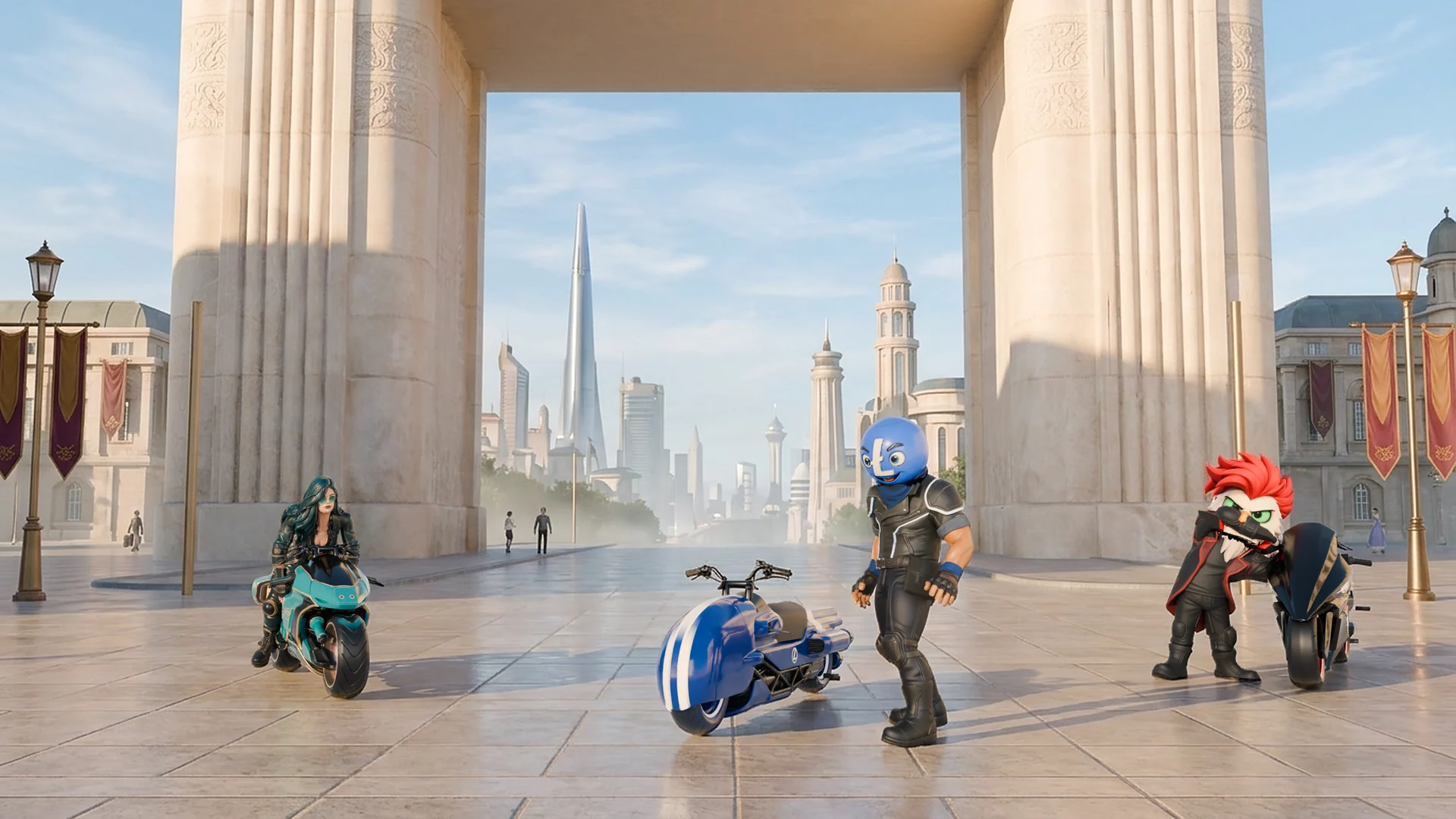
Private gatekeepers own the roads now. An independent dispatch network wants its districts back, and it needs couriers who will ride the forbidden route from Genesis Mile to the Lite Spire uplink at the far end of the city. Lester, Lilly and Chikun take the job.
The city tells the rest. It starts in marble and sunlight, the civic and trading districts of the Litecoin and LitVM side of town, then drops into three districts of smog, rain and dead neon before it climbs back into the light at the Spire. The Spire’s crown suggests an L, if you’re looking for it.
How a run works
You pick a racer, start with empty hands and ride. Each district is 6 km with a checkpoint at the end, and every seed shuffles the middle of each district, so the road isn’t the same twice. A run ends three ways:
- Finished. You reach the end of the 36 km course.
- Wrecked. Your bike’s durability hits zero.
- Out of time. A run stops after 30 minutes of riding.
There are no lives. A bad crash knocks you off for about two and a half seconds, then you’re back on, in the nearest clear lane, with a second and a half of protection, and never further ahead than you really were. Traffic, walls, gang riders and botched landings all eat into the same durability bar, so repairs matter.
Your bike tops out at 180 km/h and about 230 on boost. The boost meter drains fast and refills slowly, and tricks top it up. We built the course so that a skilled rider finishes in about twelve minutes. That’s a design target; we’ll see what real riders do.
Controls
| Do this | Keyboard | Controller | Touch |
|---|---|---|---|
| Steer | A / D or Left / Right | Left stick | Floating stick, left thumb |
| Throttle | W or Up | RT | Throttle paddle, right thumb |
| Brake | S or Down | LT | BRAKE |
| Boost | Shift | A | BOOST |
| Attack left / right | Q / E | LB / RB | The two arrow buttons |
| Use your weapon | Space | X | WPN, shown while you hold one |
| Trick (in the air) | R | Y | TRICK |
| Pause | Esc or P | Menu | II |
- Throttle latch. On a keyboard, L latches the throttle; then W raises it and X lowers it in quarter steps, so you don’t have to hold a key for 36 km.
- The paddle stays put. On touch, the throttle paddle keeps its setting when you lift your thumb.
- Nothing sticks after a pause. Pausing, switching tabs or losing a controller clears what you were holding, and you choose your throttle again (on touch: 0%, 50% or 100%) before you ride on. A controller that disconnects pauses the run.
The racers
All three share one hitbox and one set of handling rules. Their passives change how they recover, and none of them multiplies your score.
| Racer | Bike | Passive |
|---|---|---|
| Lester, courier | LES-1, the long cowl | Steady Hands: gets his balance back 10% faster after a knock that isn’t a crash |
| Lilly, mechanic | LIL-3, the race prototype | Field Engineer: repair pickups restore 10% more durability |
| Chikun, wildcard | CHK-1, the crest | Air Instinct: 10% more steering in the air and a 10% wider landing window |
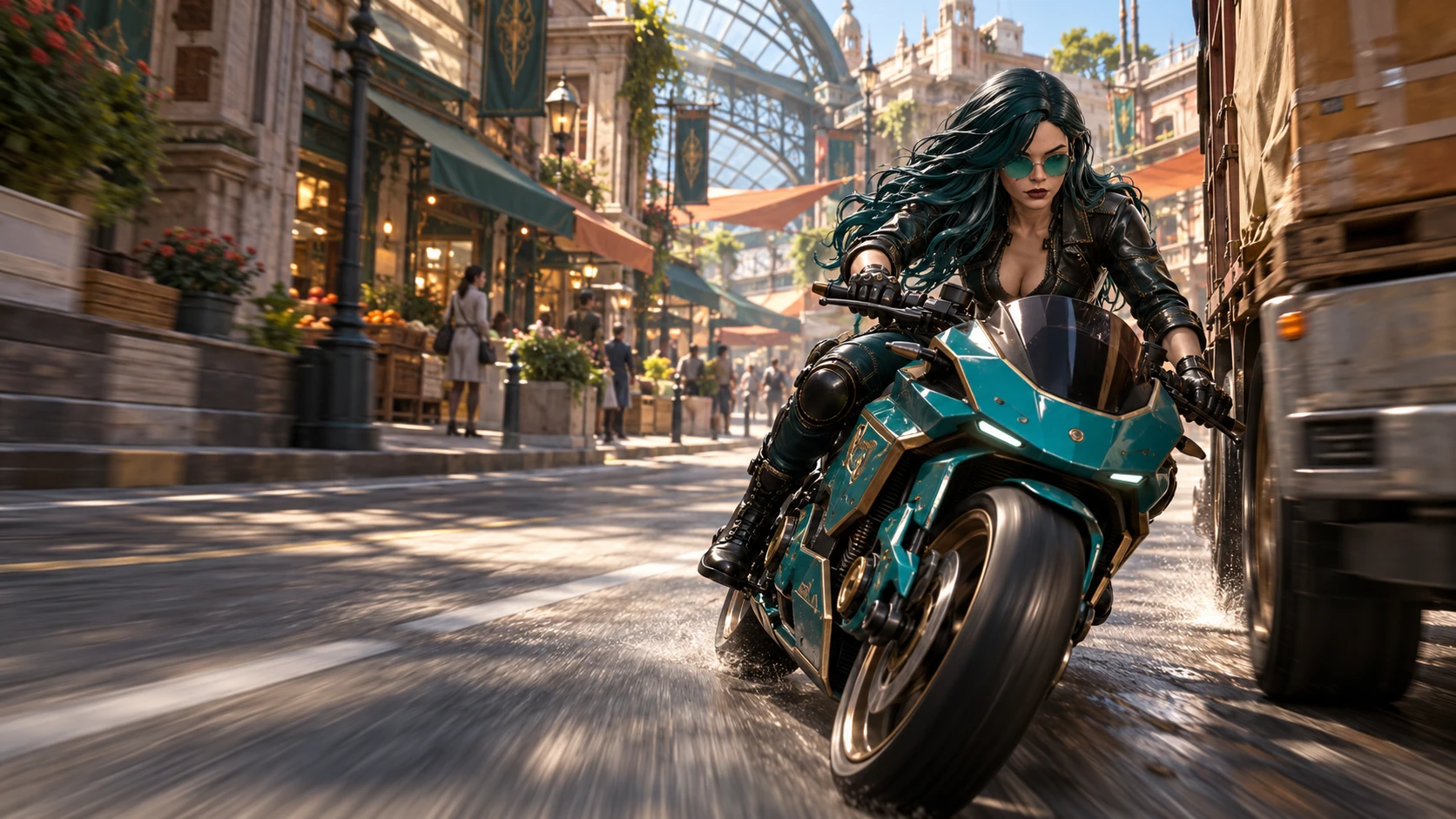
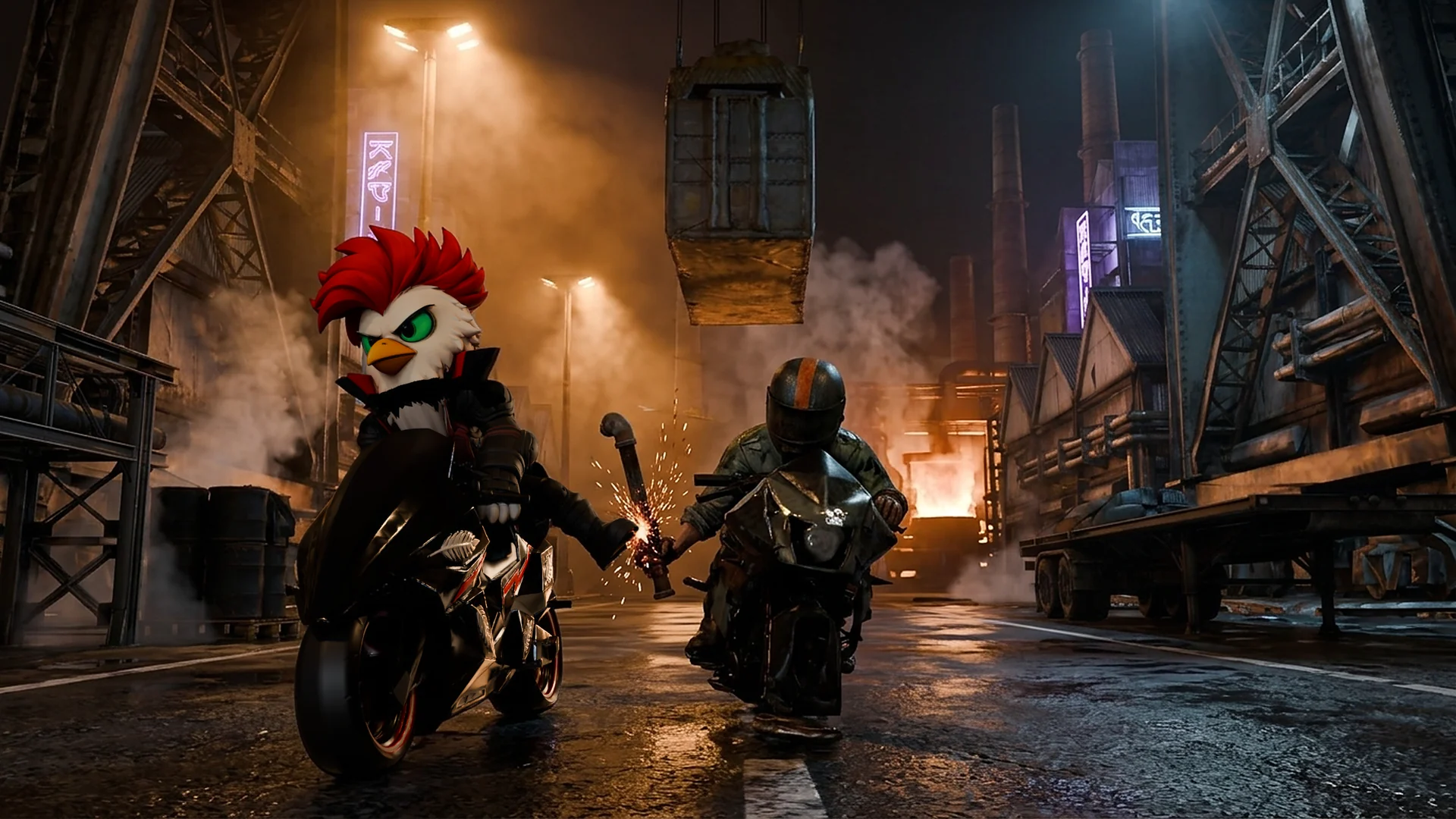
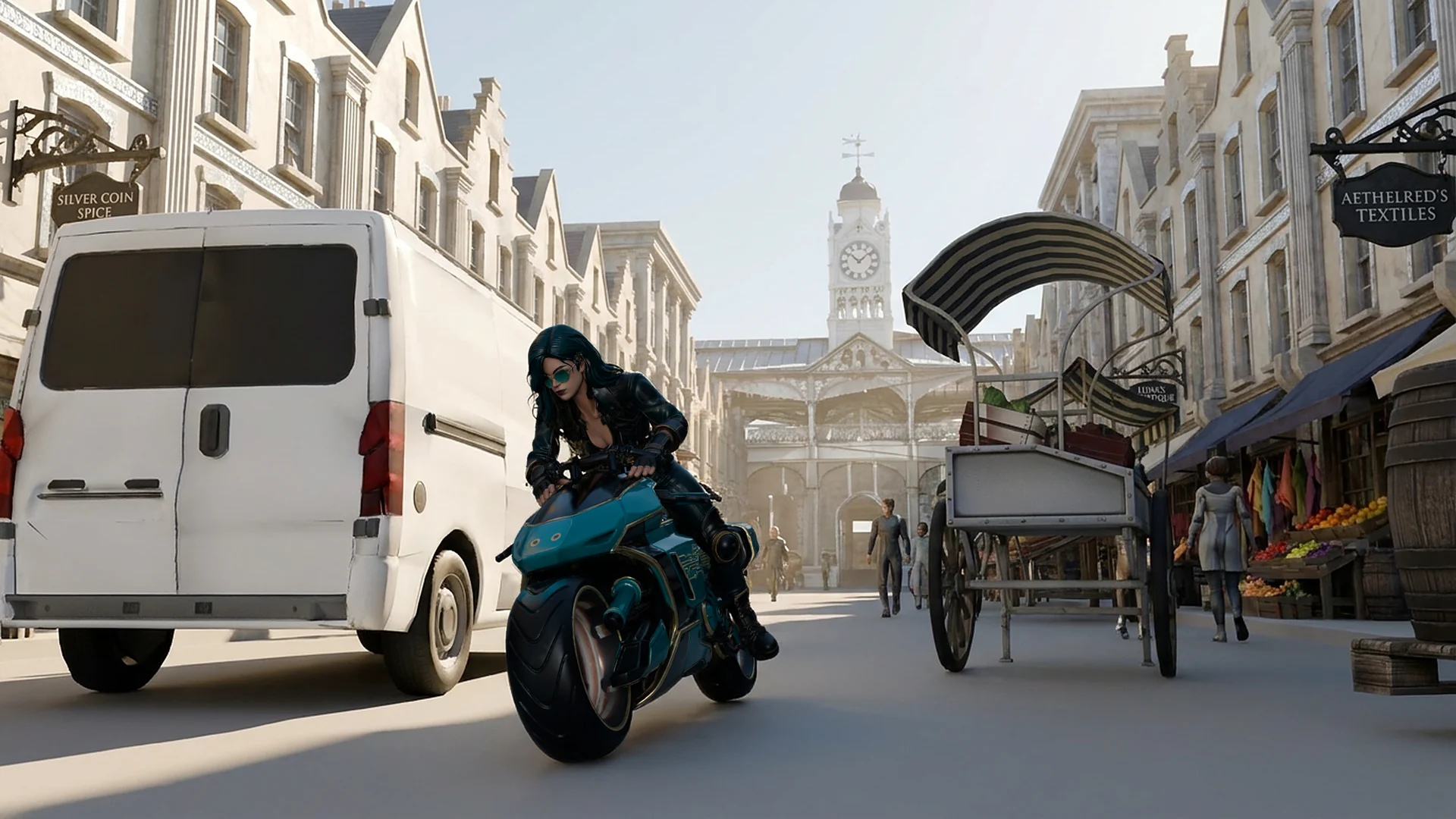
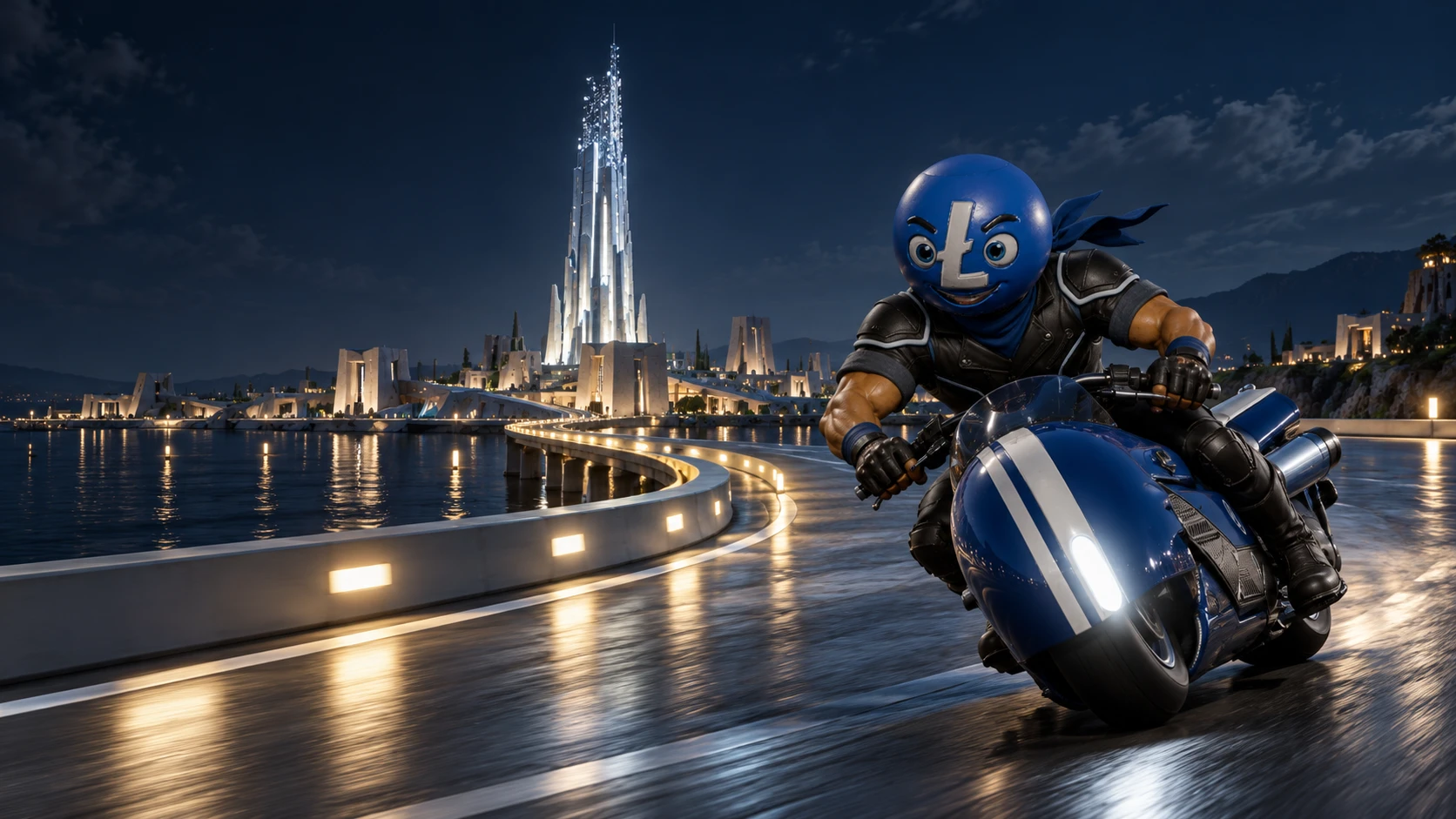
The owner asked for bikes in the spirit of Akira and Cloud’s ride in Final Fantasy VII: futuristic, a little cyberpunk, and real motorcycles with wheels. The designs are our own. LES-1 is cobalt blue with one broad white stripe, a huge rounded front cowl and a long flat tail. LIL-3 is long and low, teal with gold edges and a gold circuit trace. CHK-1 has a tall swept-back fairing that echoes Chikun’s crest, with red lightning panels and white feather vents.
Six districts
The route goes bright, then dark, then bright again.
| # | District | The look | Landmark |
|---|---|---|---|
| 1 | Genesis Mile | Limestone boulevards at dawn, copper-roofed shelters | The Dispatch Arch, 40 m across, with a bronze clock |
| 2 | Silverline Market | Late-morning trading streets, shophouses and awnings | Silverline Hall and its silver clock lantern |
| 3 | The Hashworks | A foundry at dusk under sodium lamps, smog and steam | The Number Nine Gantry |
| 4 | Forkway Interchange | Stacked wet decks at night, holo billboards, rain | The Fork, a 90 m twin-mast pylon |
| 5 | Deadchain Territory | A ruined zone after the crash, dead holo panels, puddles | A snapped span |
| 6 | Lite Spire Approach | Ceramic pavilions and causeways under a clear night | The Lite Spire, 180 m tall |
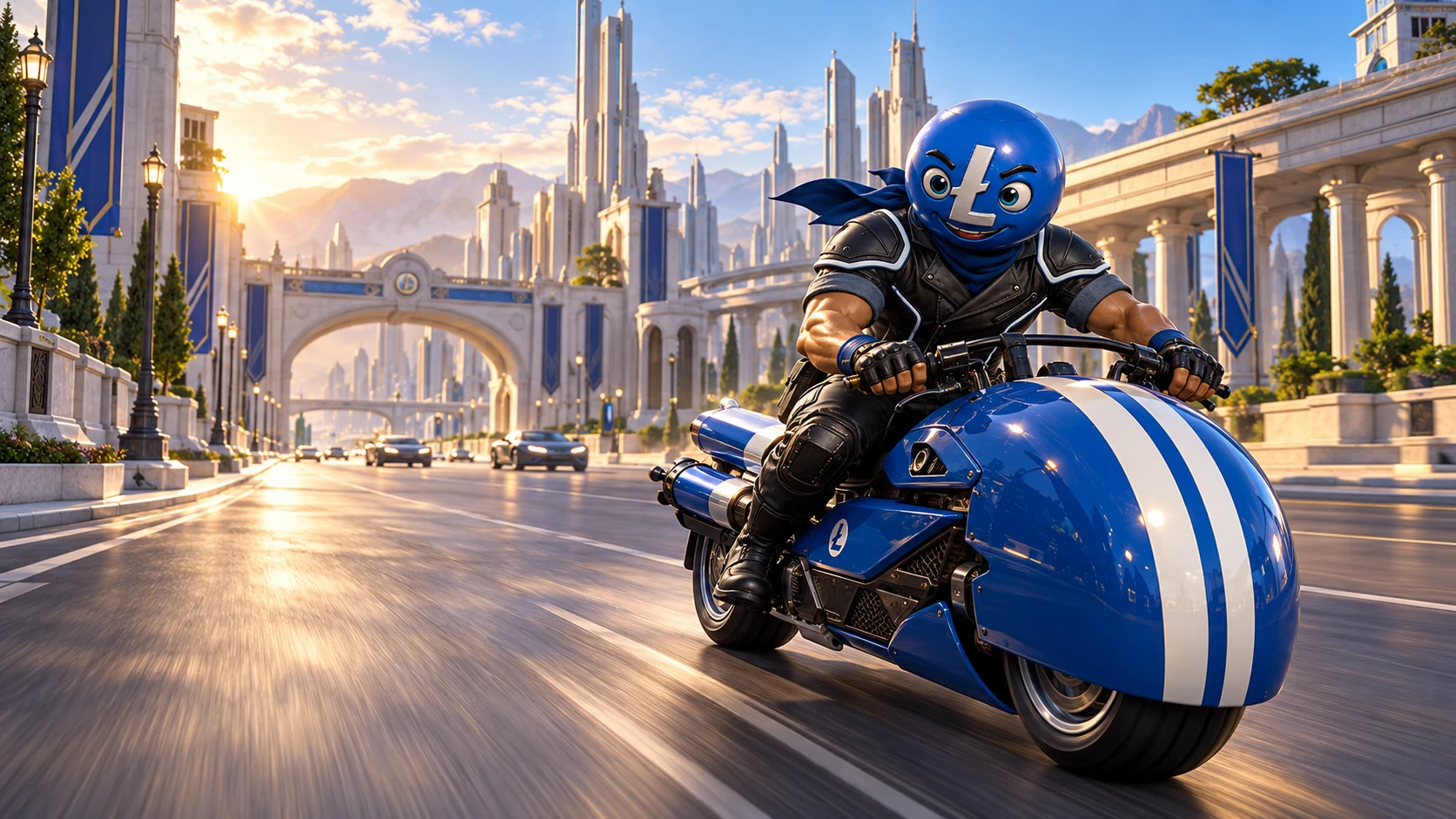
The bright city is the Litecoin and LitVM side of town: marble, sunlight, something like a future built by the ancient Greeks, and no neon. Names from the arcade’s partners are part of the streetscape here: Litecoin Foundation carved in stone on Genesis Mile, Midas and Luxxfolio on Silverline’s frontages, and Lite Strategy towers on the Spire skyline.
The dark sprawl stands for the wider crypto world beyond it, built in the grungy tradition of Blade Runner, Akira and Ghost in the Shell. The skylines of the Hashworks and Forkway carry big signs with the names of other real chains, as landmarks of the wider world you’re riding through. They’re scenery. They don’t mean any partnership or endorsement, and none of them is on a wreck, a ruin, gang turf or anything you can hit. Deadchain, the ruin, uses only made-up signs.
The city isn’t wall to wall. Every district mixes built-up stretches with open land, parks and river crossings, so the race leaves town and comes back again. Behind it all, the land runs out to the horizon: green hills and pale peaks behind Genesis Mile, slag heaps around the Hashworks, violet dark over Forkway, black ridges above Deadchain and moonlit peaks at the Spire. Where a river cuts across the route you ride over it on a bridge, with the district’s sky in the water below, which runs oily black in the dark districts.
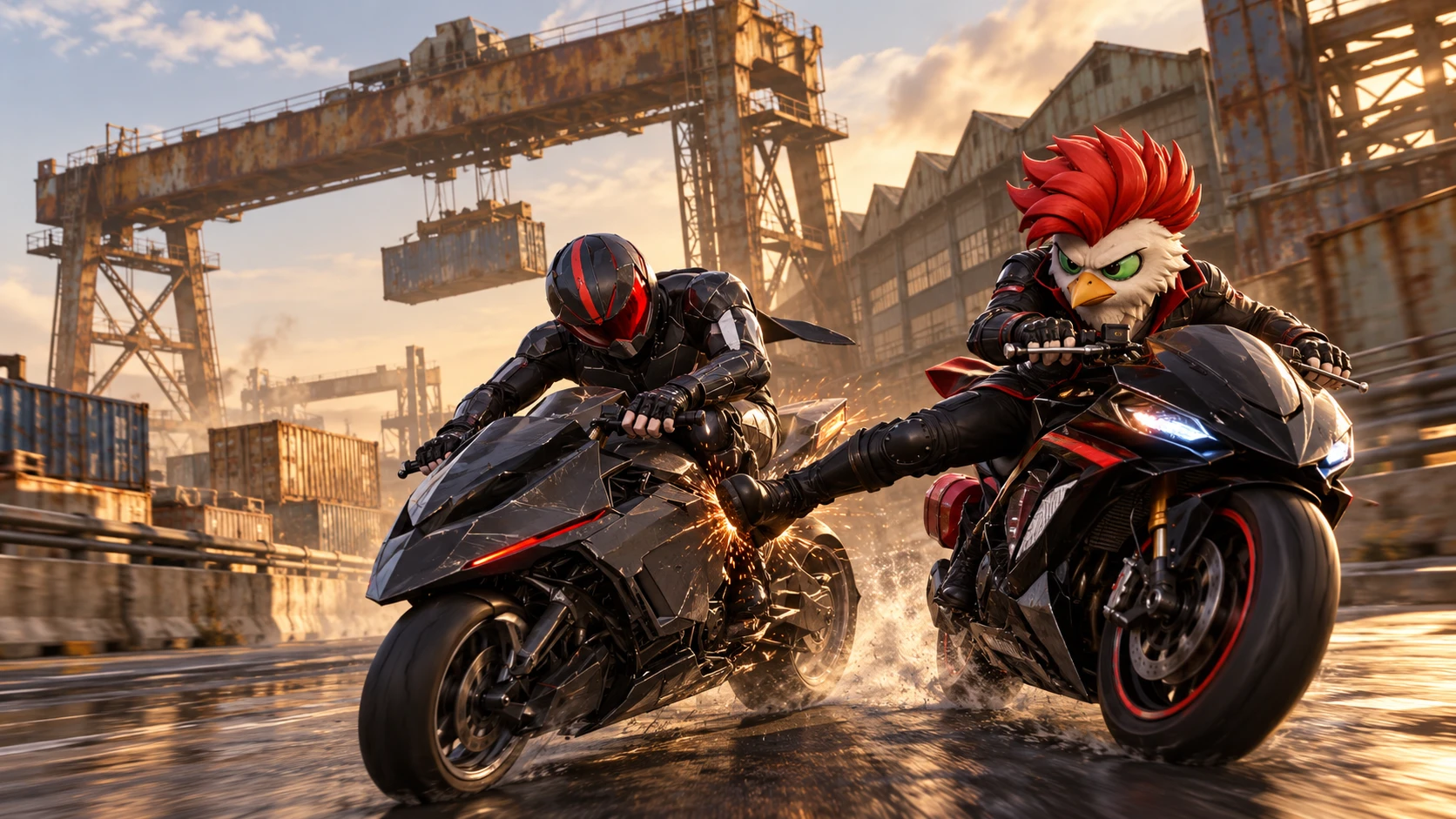
The road gets harder as you go. Traffic gets faster and thicker, from about 54 km/h in Genesis to about 86 near the Spire. Gangs come more often, and repairs get scarce: three per district at the start, one by the end. Forkway and Deadchain close lanes with tapers, and every district has a shortcut or outer lane beside the right kerb that never adds distance and always pays something: a repair, an upgrade, armour, boost and, at the end of the Deadchain shortcut, a shotgun.
Pedestrians walk the pavements in four of the districts, and they never step into the road.
Rivals and gangs
Six named riders want you off the road.
| Rider | How they ride | Where |
|---|---|---|
| Vex “Redline” Mora | Overtakes you, then brakes late | Genesis, Forkway, the Spire |
| Sable “Switch” Kade | Feints with a baton and steals your weapon | Silverline, Deadchain |
| Torque Vale | Rams and blocks lanes | The Hashworks, Forkway |
| Foreman Hex, gang leader | Swings a pipe, rides with a Ramrunner escort | The Hashworks |
| Mother Static, gang leader | Coordinates her Ramrunner and Chainrider escort | Deadchain |
| Lumen | Waits for the last 3 km, then makes two telegraphed dashes at you. Hit Lumen during the wind-up to stop one. | The Spire |
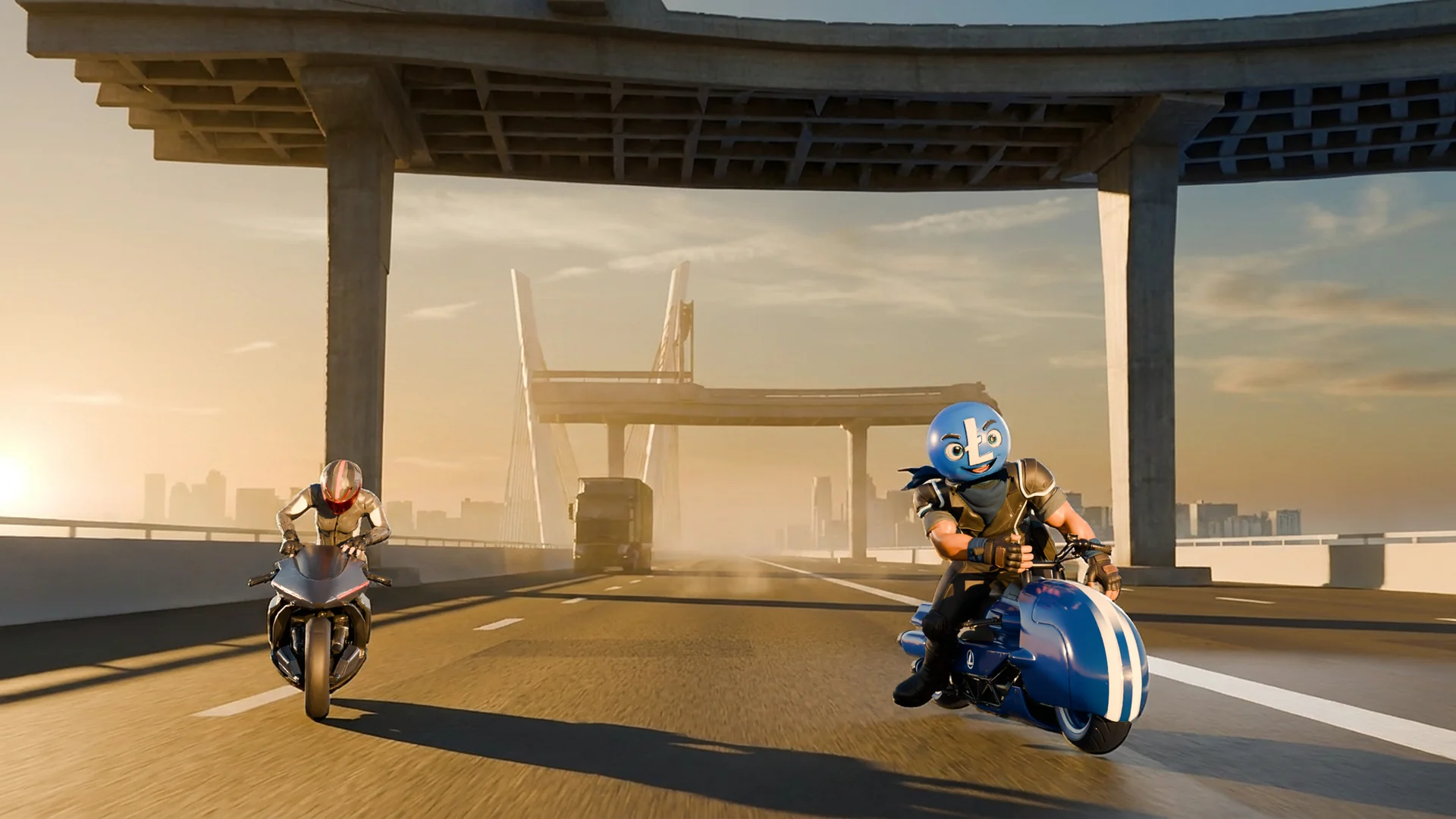
The leaders can’t be stun-locked, and you can always ride around them. The music drops back when one gets within 300 m. Between them, eight kinds of gang rider work the road:
- Ramrunners ram you.
- Cutpurses go for your weapon.
- Pipers swing lead pipes.
- Chainriders reach you from further out.
- Roadblockers sit in your lane.
- Scattergunners carry shotguns.
- Spotters never attack. If one watches you for two seconds, it calls the next gang to you early. Wreck it to cancel the call.
- Stuntriders contest the ramps. Land a precise trick beside one to upstage it: it’s stunned and you score 250.
Each one flashes a warning the first time it comes for you.
In the Hashworks, Forkway and Deadchain an armoured freight hauler rides between the traffic lanes. After a beacon warns you, it drifts one lane toward you every six seconds, but only into a lane that’s clear. It takes 90 durability to wreck and pays 800.
Fighting, weapons and tricks
Q and E attack to the left and right: a punch up close, a kick a little wider. You carry one weapon at a time, either picked up or taken off a rider you’ve staggered.
| Weapon | Uses | Damage | Notes |
|---|---|---|---|
| Shock baton | 12 | 12 | |
| Lead pipe | 8 | 16 | Pushes harder |
| Chain | 10 | 9 | The longest reach, 3.4 m |
| Shotgun | 3 shells | 30 | A forward cone out to 18 m |
- Pickups. Repairs add 25 durability, armour pickups add 20 armour that takes half of each hit, and boost cells add 40 to the meter. Upgrades for handling, acceleration, durability, boost size and boost efficiency stack up to three ranks each and last the whole run.
- Tricks. Ramps come every 800 m or so. Press trick once near the top of the jump: a precise trick scores 250 and refills 20 boost, a clean one 150 and 10. Mistime it and you land wobbly; mistime it badly and it costs durability. If you don’t press anything, you land safely and score nothing.
- Near misses. Pass traffic or a hazard within 0.6 m at speed without touching it and you score 100. Each car pays once.
Fifteen ways to score
Every source has a limit, so you can’t farm one thing all day. No points come from just surviving, and nothing scores for pedestrians or scenery. There’s no multiplier either: each source adds its own points and nothing more.
| Source | Points |
|---|---|
| Distance | 10 per 10 m, up to 36,000 |
| Checkpoints | 3,000 for each district |
| Finish | 20,000 |
| Finish pace | 25 for each second under 15 minutes, up to 7,500 |
| Finish durability | 20 for each percent left |
| Near misses | 100 each |
| Clean passes | 50 for each car passed cleanly |
| Overtakes | 150 for getting ahead of a rival and holding it |
| Hits | 25 each, for the first four on each opponent |
| Rider wrecks | 400 gang rider, 800 named rival, 1,500 leader |
| Environmental wrecks | 150 when your shove puts a rider into something |
| Weapon steals | 200 |
| Tricks | 150 clean, 250 precise |
| Shortcuts | 300 for each one you take |
| Pickups | 25, when the pickup actually helped |
Your results group them into Progress, Driving and Combat, and show your best score.
Achievements and the Locker
Lite Riders has 12 achievements, from First Dispatch and Narrow Margin (twenty near misses in one run) to Under Twelve and Gang Breaker (wreck both leaders in one run). Its Locker has five slots: bike finish, jacket accent, boost trail, landing spark and outfit.
- Bike finishes. Silverline, Scrapyard, White Courier and Deadchain, each a repainted bike with its own tail kit, from a chrome spoiler to a courier top box.
- Liveries. Two per racer: Midnight Courier and Pearl Sprint for Lester, Crimson Circuit and Graphite Teal for Lilly, Snow Rooster and Golden Crow for Chikun.
- Outfits. Two per racer: Desert Courier and Red Line Racer, White Phantom and Violet Night, Snow Coat and Royal Gold.
- Trims. The Ice boost trail, the Silver landing spark and “Three lines”, white, Litecoin-blue and copper bands on the jacket.
Every look is cosmetic, with the same size and hitbox. They’re earned from verified Ranked runs, so none can be earned yet. Free runs never unlock anything, and Ranked opens later.
How we built the city
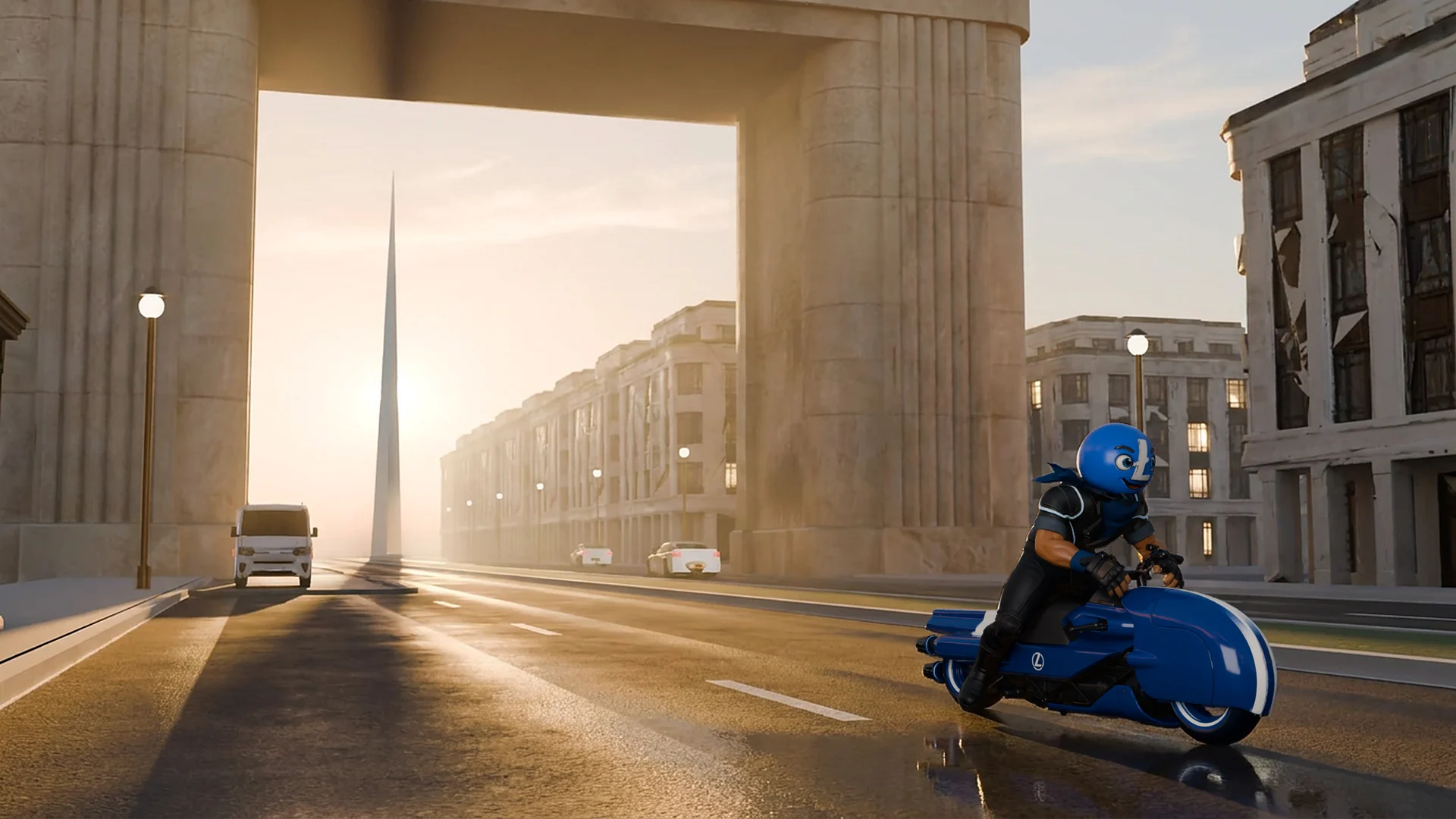
- Retro and stylised, not photoreal. The owner’s direction for both new games. Most of the detail went into Lester, Lilly, Chikun and their bikes.
- Modelled in Meshy, finished in Blender. The racers, rivals, gangs, traffic and landmarks are Meshy models. Every rider shares one 24-bone skeleton, so 38 animation clips per racer move between them, and hands and feet stay on the grips and pegs.
- Textures that load small. Over 300 models use compressed KTX2 textures, with a PNG fallback for every one.
- Readable on purpose. Signal orange, brake red, indicator amber and pickup cyan and gold are kept for hazards and pickups only. Every car we measured under the Forkway overpass stands out from the road by at least 3.1 to 1.
- The dark districts move. Light changes per district, the exposure dips as you ride into or out of the dark, steam vents, and it rains in Forkway and Deadchain. Holo flicker is capped at three flashes a second and holds still with reduced flashing on.
- Every sound is made live. The engine is two detuned oscillators with wind and boost layers, and every pass, scrape, impact, pickup and trick is built with Web Audio while you ride. Rival warnings play from the side they’re coming from. The music is the arcade jukebox.
- Sharp at speed. Edges are multisampled, four times on high and twice on medium, and every texture is filtered so facades stay crisp at the shallow angles you see them from the road. The speed effect only blurs the edges of the screen.
- Three quality levels. Low, medium and high only change how things are drawn. Traffic, hitboxes, warnings and pickups are the same on every one. If frames slow down, the game lowers its resolution for a while.
The pictures in this post are promotional art: the owner’s banners and our own renders of the game’s models.
What’s next
- Ranked. It’s wired up the same way as the other cabinets, with the arcade’s server replaying each run before anything is published. It opens after the owner signs off, on the LitVM testnet, where zkLTC has no monetary value. Achievements and Locker looks come with it.
- Phones in hand. We’ve measured Lite Riders on emulated phones. Next it gets played on real ones, to tune the touch layout and the sound.